14.9.12

GUESS WHAT?!?


Are you preparing your students to take some tests to demonstrate they've reached level A1 knowledge of English? 

I was. And I was using the official book plus CDs the publishing houses provide to get ready for the exam, when I realized that my 12 year-old student was incapable of doing a simple crossword that 'only' required her to guess what the definition referred to.

When I wrote the list of words randomly on a paper she completed the exercise in 3 minutes sharp!

What happend?  

The problem was that she didn't have the answers in a word list, so no clues at all. 
Her brain had a blackout because it couldn't elaborate the definitions and associate them to something it already knew.

I think this is rather common here in Spain because children don't usually speak English unless it's strictly required and they usually re-produce single standard expressions to verify their knowledge of grammar most of the time. 

Sometimes they write short texts, following the model presented in the book without putting any effort into the cause.

Considering that during the exam they only have a little time to complete the exercises and no teachers around for any help I decided to create a series of activities I would call 'Agility Brain' taking the cue from the most famous 'Agility Dog' training.

On this first post I'm publishing 36 cards that will work exactly like Taboo but on the opposite way. 

I chose some of the most difficult words to remember, from the vocabulary list of words our pupils have to know, to take the exam without getting into a panic.

On each card you'll find a word and from 2 to 4 definitions of it.
One of the players will read the clues,  one by one, slowly until the second player guesses which word the other is referring to.  On some cards there's a white space for a definition that the reader will invent at the same moment.

Each topic has a different pattern on the back of the card  that will be a visual clue to recognize the subject at first sight.

This way children will think in English and their brains will create faster connections between English words  and English concepts. They will learn vocabulary in meaningful phrases, not only the single words, facilitating the producing process of speaking and writing.

DON'T MISS IT!!!


More about GUESS WHAT?!?


GUESS WHAT?!? The Spelling Game


I design series of activities based on a communicative method that will help children to practice the grammar they're learning at school.

Many ESL activities, I see, are nothing more than 'fill in the blank' exercises that only teach kids how to fill in blanks and miss the whole point of learning to speak and understand a new language.

It's much easier and more fun to learn by doing, and you'll be surprised at how quickly you'll see valuable results. 

You can get my activities on my online store:

8.9.12

WE READ IT LIKE THIS blogspot.com

I would like to share with you this amazing blog about how to read illustrated stories to your children or students.  

The author, Ellen Duthie is British, but lives in Spain, and her blog includes reviews and read-aloud recordings of a selection of her favourite children's books.

Enjoy this first one: I WANT MY HAT BACK by Jon Klassen

Pay particularly attention to the rhythm, the intonation and the pronunciation. Listen to the different voices of each character that appears in the book. 

Learning these few tricks will help you to get the attention and participation of your kids during the whole story time!!!


I design series of activities based on a communicative method that will help children to practice the grammar they're learning at school.

Many ESL activities, I see, are nothing more than 'fill in the blank' exercises that only teach kids how to fill in blanks and miss the whole point of learning to speak and understand a new language.

It's much easier and more fun to learn by doing, and you'll be surprised at how quickly you'll see valuable results. 

You can get my activities on my online store:

6.9.12

TREASURE ISLAND by Robert Luis Stevenson

Had Mr Stevenson decided to keep studying engineering or law instead of following his real interest, literature, no kid since 1881 would have enjoyed this masterpiece of children's literature.

He wrote it for his 12-year-old stepson, Lloyd, and it quickly became a bestseller.

This great success was due, on the one hand, to the new ideas about children's education introduced by the recent Romantic movement,  as I've already mentioned in my Peter Pan post, and, on the other hand, to compulsory schooling that increased the literacy among the working class and consequently the audience.
Finally, new advances in printing technology allowed publishers to add colorful illustrations to books to appeal the young readers.

Actually, the map of the island, where the bloodthirstiest pirate ever to sail the Seven Seas, Cap'n Flint, had buried his 'booty' could be found in all the printed editions of the book and it gives us an idea of the adventures full of suspense we'll have if we join Jim Hawkins and the crew of the Hispaniola throughout the Caribbean sea.

The narrator is Jim, a young boy who lives and works at the Admiral Benbow Inn with his parents. At a certain point an old seaman, Billy Bones, holding a big sea-chest, appears at the door of the Inn and decides to stay for a long time, drinking huge quantities of rum a telling pirates' stories, until one day the pirate Blind Pew gives him a paper with the Black Spot indicating the time at which his old companions, Cap'n Flint's men, will arrive to kill him and take his chest to discover where the treasure is.

Billy Bones is so afraid of being killed at that very moment by an heart attack. Jim and his mother (his Father died few days before) decide to open the sea-chest to see if they can get any money of the huge amount the old captain owed to the Inn for his stay and at the same time they find the packet with the map.

Time moves fast when you're in danger and the pirates aren't trustworthy people, so it is earlier than indicated on the Black Spot when Jim hears the stick of Blind Pew getting close. They manage to run out of the Inn and hide under a bridge while the angry buccaneers are searching the Admiral Bembow looking for the papers, until the police come and all the pirates run away leaving Blind Pew heading towards the galloping horse that killed him.

Jim now has the perfect excuse to start his journey to adulthood and make his own way in the world; together with Dr Livesey and Sqire Trelawney he joins the crew of the Hispaniola, as cabin boy, in Bristol.

The most peculiar character presented in this novel is Long John Silver; a cunning, sly, one-legged man with a parrot on his shoulder: he is the pirate whom all other buccaneers in popular culture are based on.

But be careful! Even if he is an educated pirate, who can talk like a book, he's always an old sea-dog and he can change sides every time he needs to… this is the reason why adventures and suspense are behind the corner of every page!

I really recommend this book even if sometimes pirate vocabulary makes it obscure and incomprehensible.

Actually, pirate vocabulary is one of the reasons why I decide to pick it up: in my most secret dreams I can see myself leading a pirate battle among my young students.

So I did a little investigation, and here you are!!! Some of the easiest and entertaining pirates' expressions:

Ahoy      

/əˈhɔɪ/ Hello!
Avast!     

/əˈvɑːst/ Hey! Could also be used as "Stop that!" or "Who goes there?"
Aye         

/aɪ/ Yes
Aye Aye!    

Yes Sir! 
Begad!    
/bɪˈgad/ By God! 
Black Spot 
To "place the Black Spot" on another pirate is to sentence him to death, to warn him he is marked for death, or sometimes just to accuse him of a serious crime before other pirates.
Blimey!    

/ ˈblaɪmɪ/ An exclamation of surprise.
Booty       

Loot. Stolen goods. Treasure
Cutlass        

Short sword with a slightly curved blade
Doubloon

/dʌˈbluːn/ Spanish gold coin
Dog            

Bad man
Chart

Map
Gunner          

Sailor who fires the cannons
Eyepatch    

Patch worn to protect an injured eye.
Hands         

Sailors
Hook   
Jolly Roger     

Pirates' flag
Lubber        

/ˈlʌbə/ Land lover, not a sailor, a wimpy person
Maroon        

Abandon on a deserted island, a person who was abandoned
Mutiny         

/ˈmjuːtəni/ When members of a crew or army overthrow their officers
Me         

My
Pieces of Eight 

Spanish silver coin
Seafaring     

/ˈsiːfeərɪŋ/  Working or traveling on the sea
Seaman         

Sailor
Squall    

/skwɔːl/ Storm
Walk the plank 

To be forced to walk off the end of a wooden plank, fall into the sea and drown (a pirate's form of execution)
Vessel    

/ˈvesl/  Ship
Villain    

/ˈvɪlən/ Wicked person or a person guilty of a crime.

I'll leave you the link of this Pirate Song: Talk Like a Pirate for Kids,
and some very interesting activities about the topic: 

Activities about Pirates
Enjoy it!


29.8.12

PETER PAN by J.M.Barrie


This is another classic I had never read before thanks to Walt Disney's Cartoons.

Peter Pan is quite a selfish child who doesn't remember things, but at the same time he has a strong sense of justice and is always quick to help those in danger. The adventures narrated in the book are pretty famous and have been largely developed so I really couldn't imagine my own film.

Maybe this is the reason why I really enjoyed the details of this book. They are at the beginning, when the protagonist are still in the real world and fantasy is more necessary. 
Can you imagine three yawning night-lights or a twinkling little star in the Milky Way screaming: "Now, Peter!"?
Such miracles are possible only if you are a child and J.M.Barrie, the author, sensitively reminds  those who aren't so young anymore.

This book arrived when the Puritan point of view of children (necessarily disobedient like Adam) and their education (in fear of God) started to be replaced by the new Romantic movement's concepts: kids are innocent and childhood is a sacred time of life. Children's literature is seen as a way to expand their imagination and question the ready-made reality imposed by adults.

Is this why sit contains swallows build their nests in the eaves of houses to listen to stories and birds consulting maps at windy corners of the sky?

Once arrived at Neverland everything was already known and alive: the Island was exactly how its little guests have dreamt of it every night.

Another scene I found really hilarious is the one where everyone is looking for the one silently walking a few paces before him, creating a big ring of people moving all around the island the night the children were carried off in chapter twelve.

It was so inspirational that it appeared in Robert L. Stevenson's Treasure Island too.  

Fairies, flying children, pirates, indians, mermaids and Never birds come true for just a short period of everyone's life, until, like the old stars, we become glassy-eyed and stop to believe in our little fairy, killing her.

Many activities related to the story are available online:

PETER PAN LESSON PLAN by Great Ormond Street Hospital


MORE BOOKS YOU MAY BE INTERESTED IN:


JAMES AND THE GIANT PEACH by Roald Dahl


MOMO by Michael Ende


Lucy dedicates a lot of time and love to thinking about and writing the posts she shares with all of you. Because she believes that a better teaching is the key for a better future. If you find any help, value or joy in this blog, please consider becoming a supporting reader. A donation, in any amount, will be gratefully accepted. 


28.8.12

I LIKE IT! A game for young learners!


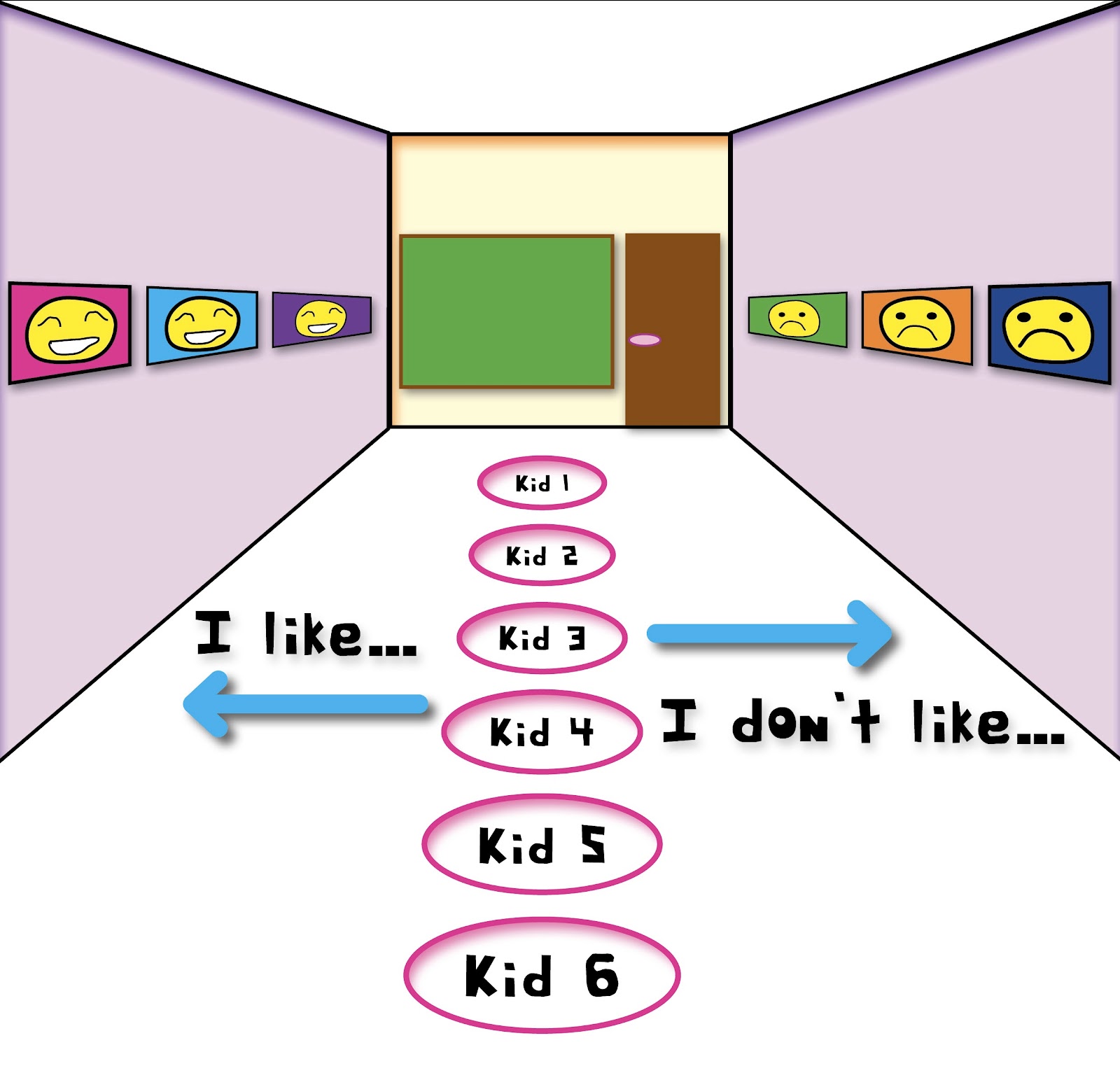
Time to teach your young learners some food vocabulary and introduce the verb 'like'?

Here's a game I tried in my class, that achieved a great success and involvement.

You'll need two opposite walls and an empty space of 3/4 square meters , food flash cards and, finally, several sheets of paper, where you will draw happy faces and sad faces. 

To avoid painful crashes among your students, calculate 1happy face every 3 children and the same for the sad faces. 
  
Stick the happy faces on one wall and the sad faces on the opposite one, at different distances from the floor.

Line up your students between the two walls, in the middle of the area.


Stand in front of them and show the first flash card, a strawberry, for example, and say: 
"I like strawberries" or "I don't like strawberries".

When they hear "I like" they will have to run towards the happy faces to touch them.

On the other hand, if they hear "I don't like" they will run towards the sad faces on the opposite wall.

Speed of sentences depends on their level of attention and age.
Try slowly first. With 3 to 4 ones it's enough. 
5 year old ones are faster and, mine at least, enjoyed running quickly and splatting themselves against the wall (!!!!)

The second time you can give 2 or 3 flash cards to a volunteer and let him say the sentences.

Once again: HAVE FUN!!!

P.S. You can also try different vocabulary sets, like animals, verbs, etc.

20.8.12

JUMPING IN AND OUT OF SHAPES

I'll tell you a secret: I wrote on the floor of my classroom with a piece of chalk during some of my English classes (!!!!!).

I was teaching opposites using an illustrated book when suddenly I had an epiphany: join two topics to a kinesthetic experience!

So, I started to draw shapes like circles, triangles and rectangles on the floor -avoiding squares, because they are too difficult to define without a ruler and to distinguish from a rectangle by a 4 to 5 year old child.

Later you can add hearts, stars and diamonds.

The funniest thing was my student's first reaction to my unusual behavior:
one immediately erased every single line I had drawn and another warned me she would report me to their head teacher…ahahahah

They weren't expecting an adult to draw on the floor at all!!!

I had to reassure them explaining we were going to clean it after the activity so they finally decided to give me a hand filling the floor with a huge quantity of shapes… 
At the end it was difficult to stop them!

And here we are, with our set ready to be used.
Be sure to leave some space between your shapes and tell them to jump in and out of them.

Do it slowly at the beginning and increase the speed once they've got the different shapes' names.

You'll notice after a while that one or more of your students will feel a strong desire to lead the game, which is exactly what you want!!!

Give it a try and jump!!!

29.7.12

LITTLE HOUSE ON THE PRAIRIE by Laura Ingalls Wilder


Finally, after spending part of my childhood watching Laura Ingalls Wilder's exciting experiences on TV I made up my mind to read this book out of the long series of the Little House books.

Little House in the Prairie is  a one year journal about Laura' s family and its adventures and daily life on the vast prairie. 

Charles and Caroline, respectively Pa and Ma, load their covered wagon with a few basic things and their three daughters, Mary, Laura and baby Carrie, to move from the crowded Big Woods, in Wisconsin, to the Indian Territory, which, as Charles has been told, is about to open to settlement.

After crossing the Mississippi river and several more frozen streams they stop and start  their new lives  on the immense prairie, 40 miles south of Independence, Kansas. 

At this point the book change into a boy scout manual. 

Long descriptions of the surrounding environment introduce us to all kinds of plants and animals that live on the Prairie.

Plenty of details are provided about how to build a house, its fireplace, the chimney  (beds, tables, rocking chairs, the well, the stable etc.) only using natural material like logs, rocks, and mud plus some tools and a few nails. Actually at one point Pa runs out of nails, but this inconvenience doesn't stop him making a completely nail free door. 

Charles Ingalls hunts to get fresh meat to eat and furs to sell up in Independence to make money and buy things like sugar or tobacco, but especially seeds to start growing the family's own food.

An interesting point of view is presented when they meet Indians. Pa is willing to create a respectful relationship in order to avoid any problems. Ma doesn't like them at all, Mary is scared but Laura is absolutely curious about them and she especially wants to see a 'papoose'. 
Actually Laura is the only one who questions the right of settlers to occupy Indian Territory. 

Good relationships among neighbors are another special topic of the book. Helping  each other is definitively essential to survive on that rough land where "fever n' ague", wolves, panthers or even a prairie fire could end your life at any moment. 

I suppose that this is one of those fundamental books to use to teach your students one of the most important moment in American history. 

It's engaging and can inspire many school activities to go deeper into how people lived in the 19th Century. 
Here on these web pages you can find some ideas to make the most of them.