29.8.12

PETER PAN by J.M.Barrie


This is another classic I had never read before thanks to Walt Disney's Cartoons.

Peter Pan is quite a selfish child who doesn't remember things, but at the same time he has a strong sense of justice and is always quick to help those in danger. The adventures narrated in the book are pretty famous and have been largely developed so I really couldn't imagine my own film.

Maybe this is the reason why I really enjoyed the details of this book. They are at the beginning, when the protagonist are still in the real world and fantasy is more necessary. 
Can you imagine three yawning night-lights or a twinkling little star in the Milky Way screaming: "Now, Peter!"?
Such miracles are possible only if you are a child and J.M.Barrie, the author, sensitively reminds  those who aren't so young anymore.

This book arrived when the Puritan point of view of children (necessarily disobedient like Adam) and their education (in fear of God) started to be replaced by the new Romantic movement's concepts: kids are innocent and childhood is a sacred time of life. Children's literature is seen as a way to expand their imagination and question the ready-made reality imposed by adults.

Is this why sit contains swallows build their nests in the eaves of houses to listen to stories and birds consulting maps at windy corners of the sky?

Once arrived at Neverland everything was already known and alive: the Island was exactly how its little guests have dreamt of it every night.

Another scene I found really hilarious is the one where everyone is looking for the one silently walking a few paces before him, creating a big ring of people moving all around the island the night the children were carried off in chapter twelve.

It was so inspirational that it appeared in Robert L. Stevenson's Treasure Island too.  

Fairies, flying children, pirates, indians, mermaids and Never birds come true for just a short period of everyone's life, until, like the old stars, we become glassy-eyed and stop to believe in our little fairy, killing her.

Many activities related to the story are available online:

PETER PAN LESSON PLAN by Great Ormond Street Hospital


MORE BOOKS YOU MAY BE INTERESTED IN:

JAMES AND THE GIANT PEACH by Roald Dahl


MOMO by Michael Ende


Lucy dedicates a lot of time and love to thinking about and writing the posts she shares with all of you. Because she believes that a better teaching is the key for a better future. If you find any help, value or joy in this blog, please consider becoming a supporting reader. A donation, in any amount, will be gratefully accepted. 


28.8.12

I LIKE IT! A game for young learners!


Time to teach your young learners some food vocabulary and introduce the verb 'like'?

Here's a game I tried in my class, that achieved a great success and involvement.

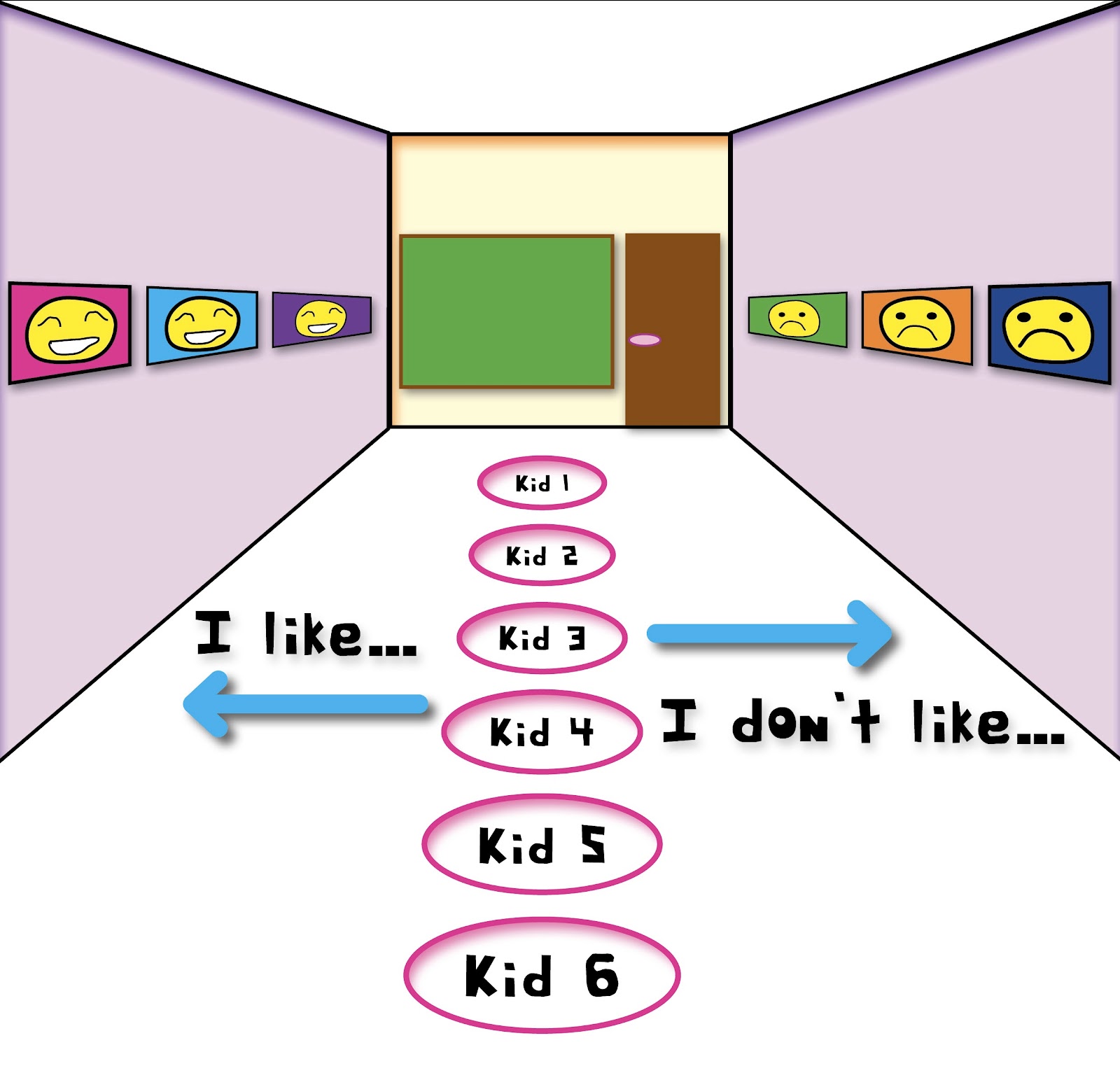
You'll need two opposite walls and an empty space of 3/4 square meters , food flash cards and, finally, several sheets of paper, where you will draw happy faces and sad faces. 

To avoid painful crashes among your students, calculate 1happy face every 3 children and the same for the sad faces. 
  
Stick the happy faces on one wall and the sad faces on the opposite one, at different distances from the floor.

Line up your students between the two walls, in the middle of the area.


Stand in front of them and show the first flash card, a strawberry, for example, and say: 
"I like strawberries" or "I don't like strawberries".

When they hear "I like" they will have to run towards the happy faces to touch them.

On the other hand, if they hear "I don't like" they will run towards the sad faces on the opposite wall.

Speed of sentences depends on their level of attention and age.
Try slowly first. With 3 to 4 ones it's enough. 
5 year old ones are faster and, mine at least, enjoyed running quickly and splatting themselves against the wall (!!!!)

The second time you can give 2 or 3 flash cards to a volunteer and let him say the sentences.

Once again: HAVE FUN!!!

P.S. You can also try different vocabulary sets, like animals, verbs, etc.

20.8.12

JUMPING IN AND OUT OF SHAPES

I'll tell you a secret: I wrote on the floor of my classroom with a piece of chalk during some of my English classes (!!!!!).

I was teaching opposites using an illustrated book when suddenly I had an epiphany: join two topics to a kinesthetic experience!

So, I started to draw shapes like circles, triangles and rectangles on the floor -avoiding squares, because they are too difficult to define without a ruler and to distinguish from a rectangle by a 4 to 5 year old child.

Later you can add hearts, stars and diamonds.

The funniest thing was my student's first reaction to my unusual behavior:
one immediately erased every single line I had drawn and another warned me she would report me to their head teacher…ahahahah

They weren't expecting an adult to draw on the floor at all!!!

I had to reassure them explaining we were going to clean it after the activity so they finally decided to give me a hand filling the floor with a huge quantity of shapes… 
At the end it was difficult to stop them!

And here we are, with our set ready to be used.
Be sure to leave some space between your shapes and tell them to jump in and out of them.

Do it slowly at the beginning and increase the speed once they've got the different shapes' names.

You'll notice after a while that one or more of your students will feel a strong desire to lead the game, which is exactly what you want!!!

Give it a try and jump!!!

29.7.12

LITTLE HOUSE ON THE PRAIRIE by Laura Ingalls Wilder


Finally, after spending part of my childhood watching Laura Ingalls Wilder's exciting experiences on TV I made up my mind to read this book out of the long series of the Little House books.

Little House in the Prairie is  a one year journal about Laura' s family and its adventures and daily life on the vast prairie. 

Charles and Caroline, respectively Pa and Ma, load their covered wagon with a few basic things and their three daughters, Mary, Laura and baby Carrie, to move from the crowded Big Woods, in Wisconsin, to the Indian Territory, which, as Charles has been told, is about to open to settlement.

After crossing the Mississippi river and several more frozen streams they stop and start  their new lives  on the immense prairie, 40 miles south of Independence, Kansas. 

At this point the book change into a boy scout manual. 

Long descriptions of the surrounding environment introduce us to all kinds of plants and animals that live on the Prairie.

Plenty of details are provided about how to build a house, its fireplace, the chimney  (beds, tables, rocking chairs, the well, the stable etc.) only using natural material like logs, rocks, and mud plus some tools and a few nails. Actually at one point Pa runs out of nails, but this inconvenience doesn't stop him making a completely nail free door. 

Charles Ingalls hunts to get fresh meat to eat and furs to sell up in Independence to make money and buy things like sugar or tobacco, but especially seeds to start growing the family's own food.

An interesting point of view is presented when they meet Indians. Pa is willing to create a respectful relationship in order to avoid any problems. Ma doesn't like them at all, Mary is scared but Laura is absolutely curious about them and she especially wants to see a 'papoose'. 
Actually Laura is the only one who questions the right of settlers to occupy Indian Territory. 

Good relationships among neighbors are another special topic of the book. Helping  each other is definitively essential to survive on that rough land where "fever n' ague", wolves, panthers or even a prairie fire could end your life at any moment. 

I suppose that this is one of those fundamental books to use to teach your students one of the most important moment in American history. 

It's engaging and can inspire many school activities to go deeper into how people lived in the 19th Century. 
Here on these web pages you can find some ideas to make the most of them.


26.7.12

THE BALL GOES TO…


Hello everyone! I'm back for a little while. I've been busy working in a summer camp here in Madrid and I'm alive! Well…half alive. 

But alive enough to tell you about this ball game I've been taught by a child named Alvaro.

You just need a ball and a quite large area, like a playground or a garden. 
I suppose you can even try an aquatic version of it.

Oh! And at least 4/ 5 children. The more, the better.

Each child has to choose the name of an animal and announce his name to the rest of the group.
One child holds the ball and says: " The ball goes to… Dolphin!"
And he throws the ball in any direction. 

This way the kid named Dolphin will run after the ball while the rest of the players will run away in order to be as far as possible from the Dolphin.

Once Dolphin has caught the ball, he will shout: "STOOOOP!!!!" and everyone will freeze. 

At this point of the game, Dolphin can take only three steps holding the ball to get as close as possible to one of the frozen players. Then he will throw the ball toward one of them and if the ball touches the frozen kid he will be out.

The game continues with Dolphin saying:  " The ball goes to…"

It's really fun! Thank you Alvaro!!!


MORE GAMES:

PHONETICS - The S game


CIRCLE GAMES - The Shoe Behind You

13.6.12

MATILDA by Roald Dahl


I must admit that I love Roald Dahl's  books, because they are like modern fairy tales and also because of his way of making you feel you're beside the protagonists, submerged in their own world, as wide as the book you're holding in your hands.

Matilda is a gifted little girl who is not really appreciated by her parents, especially because she is absolutely not interested in watching telly (TV). 

What our heroine really enjoys is reading books to escape from her family's bad attitude towards her.

Actually Dahl, in this last book of his career, has left us many titles of the best literature ever, both for children and young adults. Books that Matilda devours and, even if sometimes she doesn't understand everything is written in them, she gives us the clue to decide if an author is good or not: "The way he (Hemingway) tells it I feel I am right there on the spot watching it all happen"
There are several levels to read Matilda, first of all the open criticism of the TV and people who waste their time in front of it instead of reading a book. 

If you have no idea how to choose a good one, just follow Dahl's suggestions! From Dickens to Orwell, passing thrugh Brontë, Kipling, Steinbeck and many more, you won't be disappointed at all.

Matilda's parents are products of TV culture: superficial, ignorant and rude people whose main worry is money. 

They disapprove and bully their daughter to discourage her from reading.

Matilda, on the other hand, doesn't give up and, as a young courageous protagonist, starts her adventure for independence and personal growth going to the library by herself.

The author also gives us his definition of a teacher:
"…most head teacher are chosen because they possess a number of fine qualities. They understand children and they have the children's best interests at heart. They are sympathetic. They are fair and they are deeply interested in education."

At certain point of the book Dahl resorts to paranormal powers, jumping into Fantasy.
Matilda discovers that through intensively glaring  at objects she can make them move the way she wants. 
Thanks to this super power she will rescue her ally, Miss Honey to get rid of the terrible Miss Trenchbull, a nightmare for the whole school. 

Firstly she tips a glass over. Then she tries to lift a cigar and finally she manages to scare the Trenchbull to death, writing a message on the blackboard of her classroom with a piece of chalk moved only  by her psychic power.

This  super mental power is clearly a metaphor of the great willingness power belonging to everyone and capable to influence the development of events and she gives us the key of a successful life:
"She knew she wouldn't manage it right away, but she felt confident that with a great deal of practice and effort, she would succeed in the end. "

Finally, in this novel, as in James and the Giant Peach or in Charlie and the Chocolate Factory, we can easily distinguish many Propp's Functions, too.

A very interesting and deep analysis of their appliance to Matilda's story is explained in detail in this conference extract :

If you're thinking about assigning Matilda as compulsory or suggested reading for summer, for example, on this link you'll find many activities, worksheets, questions and lessons ideas to work on it with your students:
MORE BOOKS


Lucy dedicates a lot of time and love to thinking about and writing the posts she shares with all of you. Because she believes that a better teaching is the key for a better future. If you find any help, value or joy in this blog, please consider becoming a supporting reader. A donation, in any amount, will be gratefully accepted.