9.11.12

MEET THE ANIMALS!, by Stephane Husar and Loïc Méhée

Today I'm talking about the second book of Cat and Mouse, edited by Anaya, that invite our young learners to get to know the animals!

Meet the Animals Cover
As animals are their favorite subject at this age (3-4-5) you won't have any problem capturing their total attention.

Exactly like in the previous one, Cat and Mouse - Learn the Colours!, we'll meet again the main protagonists, the big-headed orange cat and the little squeaky mouse, but this time they will introduce us to some farm and jungle animals.

The dialogue structure is repetitive and catchy and apart from animals' names we'll also discover their noises. Do you know what kind of noise a sheep makes?

After reading it I added some more activities as always.

First of all I seized the moment to teach the most appropriate song 'Old MacDonald' mentioning the farm animals we saw in the book.

I used this song during the next classes to play 'Musical Chairs' and the 'Statue Game': they were allowed to dance when the music was on but they had to freeze in position and hold it when the music was off.

Then I stuck some flashcards representing the animals from the book on the wall and lined my kids up into two queues. When I called out an animal they had to run towards the right card and touch it. 

You can also make the noise and they have to say the name and touch the corresponding animal.

Another game they love is performing the animals. Make them sit on the floor in a semicircle, call a student out, show him a card. He has to perform the animal and the rest of the class has to guess the animal performed.

Afterwards you can play again the "I spy" and "I can see a…across the sea" games. 

Finally if you have worksheets to color, that will help too.

This book has also a CD that you can use to make them listen and repeat. 
Actually it contains a lot of nature's sounds and my pupils enjoyed it quite a lot.

I still haven't tried the 'Theatre', but I've already noticed them saying stray sentences from the book, so I imagine it's not going to be difficult to arrange it. 

Have fun!


4.11.12

PIPPI LONGSTOCKING by Astrid Lindgren


Pippi Longstocking Cover
I suppose that many of us watched Pippi's adventures on TV when we were children and, maybe, some of her brilliant unconventional ideas are still stored in our subconscious. In my personal experience I still dust my parquet - floor skating on a pair of dust cloths, a technique she invented first, I suppose, and, oh yes! it's fun! 

So, for those who have never heard about her, Pippi has been labelled as the naughtiest girl ever, a little 'savage' whose mother died and whose father was washed overboard in a storm at sea. She lives on the outskirt of a Swedish town with a monkey and a horse parked on the porch of Villa Villekulla.

She is the strongest girl on earth and also the most brave of all. She tells lots of lies, although I'm sure Gianni Rodari would have called them creative stories.

Her character was created when Sweden was being transformed, from a poor agricultural country, into a rich and wealthy nation, and the Swedish culture of conformity, moderation, constraint and contentment was definitively modeling the stereotype of "calm, clean, quiet, industrious and modern" Swedish society.

Can you imagine the expression of horror on the editor's face during the reading of Pippi's book? Actually Astrid Lindgren didn't get published on her first try.
The character of Pippi was so outrageous that the publisher rejected her!

What would you think about a kid who dramatically messes up the kitchen, exactly like The Cat in the Hat by Dr Seuss, to cook pancakes and rolls shortbread on the floor?

And what about school? She's never gone and even when she tries, she really doesn't fit in! She doesn't treat her teacher respectfully, she is noisy, she lies, she draws on the floor and she doesn't participate when she is required to.
Her one-day teacher was actually really lucky when Pippi decided to drop school out after just a few hours.

But on the other hand, she is the best at inventing games to play with her young next-door  neighbors Tommy and Annika. Every afternoon they can be 'thing searchers' or can have coffee and cookies sitting on the branches of a tree, they can go walking in the wood and have any sort of adventures or ghost-hunting in the attic of Villa Villekulla. 

No matter how uneducated she is, she will always be children's favorite heroine!

Take a look at these classroom activities here: 
Pippi - Study Guide


Lucy dedicates a lot of time and love to thinking about and writing the posts she shares with all of you. Because she believes that a better teaching is the key for a better future. If you find any help, value or joy in this blog, please consider becoming a supporting reader. A donation, in any amount, will be gratefully accepted. 


24.10.12

WRITING TIP Nº1: The Fantastic Binomial


I've decided to present, starting from this post, a series of writing tips that you can easily use in class.

Inspired by Gianni Rodari's Grammar of Fantasy I want to spread his brilliant ideas all around the world to improve story telling and creating.

In this first post I'll be talking about the 'fantastic binomial', a simple technique I'm sure will spark many funny moments in addition to great compositions!

According to several theories the human brain elaborates concepts from opposite pairs. This means that the idea of 'soft' can't exist in our mind without thesimultaneous experience of 'hard'.

To make up a story, as well, two non related-words are necessary.
I mean, daisy and daffodils are an example of related words that will inspire a few ideas but not enough for a story.

Let's think about some examples of non-related words:

Pepper and Football
Penguin and Hot-air Balloon
Egg and Diary

Do you think they are distant enough to wake up your imagination?

Several ways exist to choose these words: pointing to them in a dictionary, letting each student  write one on a piece of paper etc.

Once you've got your two distant items you must connect them, through preposition, for instance:

The penguin on the bus
The penguin under the bus
The penguin with the bus
….
Are you getting inspired?
We've already got many points of departure to develop a whole story.

I'll use the Egg and the Diary

The Egg's Diary could be a good one with the Egg as main protagonist and narrator at the same time. Can you imagine?

Gemma the Egg is happily living her life on the farm when suddenly she's told by her neighbor in the egg compartment that she will be probably e part of a Spanish tortilla (omelette) the next day. Horrified by the idea Gemma decides to run away and, since she went to school at the farm, she's capable of writing about her adventures in the diary received  as a present from her mum.

A diary that, due to some lucky coincidences, is now in our possession…

Of course this is only a story idea  but it can be developed by the students: each one, in sequence, can write a chapter that will continue the previous one to create a collective classwork.

That's all for now. See you soon for the second Writing Tip.


14.10.12

LEARN THE COLOURS! by Stephane Husar and Loïc Méhée


A new school year has just begun and I've been assigned to a pre-school mixed group of old students of mine, aged 5, and new students, aged 3.

The main challenge, in this situation, is how to present topics that my old pupils already know to the new ones without being boring and using material and books they haven't seen yet.

It's a really difficult problem to work out!

Fortunately, I came across this bilingual book collection, 'Aprende Inglés con Cat and Mouse', edited by Anaya, which in some way partially solves my problem, at least until Christmas! 

The first book I've been using over the past two weeks talks about colors, as you can read on the title. 

Cat and Mouse are the main characters who will show many balloons and teach your kids what colors they are.

The book scheme is really basic and repetitive, the pictures are colorful and bright: elements, as already mentioned in my previous post about teaching from books, that make it easier to convince young minds that a new language can be simple and fun to learn.

To complete the color experience I added complementary fun activities to involve all my students' faculties in the learning process.

First day:
I read the book aloud and then I played the game 'Touch something… Red!' 
As you can imagine it's a game where they have to run around the classroom to touch something colored as I require.

Finally we sat down to paint a clown holding several balloons, each one had an assigned color written in it. This way the oldest children could start reading and recognizing the colors' spelling while the youngest ones just had to listen to me pronouncing the color's name and choose the right crayon to paint the balloon.

Second day:
We listened to the Cd that comes with the book, repeating the lines.

Then I drew some balloons on several sheets and let the children paint them using their favorite color.
Afterwards, using the same drawings, we played a game they really love.

There is a child who's the captain of the ship and stands alone at one side of the classroom. At the opposite side, there is the rest of the class (lees one) holding usually flashcards but in this case the sheets previously painted.

Finally there is one kid who's going to be the shark, placed more or less at the same distance from the captain and the rest of the classmates.

When the captain calls out a card, pronouncing these words "I can see, I can see a blue balloon across the see!!!", the student holding the blue card has to run towards him avoiding the dangerous shark's clutches!

This game is also helpful to start to get used to saying adjectives before nouns.

Third day:
I proposed that we perform a little play using the book's lines as a script.
So, two by two, each one holding a flashcard respectively showing a cat and a mouse, recited the lines while the rest of us were holding the sheets with the different colored balloons.
I can say it was great and un unexpected success!
The oldest ones, after just a minute, were acting by themselves and the youngest were, little by little, recognizing and pronouncing the correct balloon's color. 
Beside, it's an activity you can repeat several times over the month. It seems they don't get tired of it! 

After the 'theatre' we sat down to play the "I spy" game. 
Display some animals flashcards on the table (but you can use anything colored), and then say: "I spy something with my little eye…" They must ask "What color is ti?" Tell them the color you're thinking about and they have to point to the card showing the color you said.

In this case the oldest were reviewing animal vocabulary at the same time that the youngest enjoyed the pointing experience. They loved it!

I hope I've been helpful. I'll soon review more books and present more related games and activities.

You can take a look at the whole collection on Anaya's page: Aprendo inglés con Cat and Mouse

11.10.12

ROUND OF QUESTIONS


One of the main speaking exercise I constantly perform with my students, right at the beginning of the class, is the 'Round of Questions'.

Once they are sitting in a semicircle you can start to ask the student sitting beside you the first question.

- How are you?
- What's your name?
- How old are you?
- Where do you live?
- What's your favorite color/ animal / food?

These inquiries and their respective answers are the goals you can achieve with pre-school children.

You can add more complex questions for higher-level students.

The child, sitting beside you, must answer and then ask the same question to to the one sitting next to him and so on until the question will reach you again.

It should be a fast-pace game to avoid general boredom.

At the beginning it will be naturally slow because the kids will have to learn the right words to use and you'll notice their certain tendency to divert their attention toward anything but the performance. Don't give up and be firm.

To make it more engaging I also use a little soft ball. I throw it to the chosen 'victim', who after answering will redirect it to anyone he chooses asking, of course, the same question and so on.

The problem with this solution is that you will have, and I am almost 100% sure of it, someone of them trying to throw the ball as high or far as possible instead of his/ her classmate… 
When that happens, definitely write his/her name under the sad face on the board!!! ;o)

Recently, i successfully introduced a box into which they have to throw the ball or a puppet or something soft you keep on hand, exactly like basketball.

It helps to avoid balls flying everywhere inside the classroom with the consequent mess. 

All of your pupils, with no exception of age, attitude and ability will participate with sincere thrill and joy!!!

Do you know any best way to start an English class?!?


I design series of activities based on a communicative method that will help children to practice the grammar they're learning at school.
Many ESL activities, I see, are nothing more than 'fill in the blank' exercises that only teach kids how to fill in blanks and miss the whole point of learning to speak and understand a new language.
It's much easier and more fun to learn by doing, and you'll be surprised at how quickly you'll see valuable results. 
You can get my activities on my online store:
http://childreneslworksheets.bigcartel.com

8.10.12

TEACHING ENGLISH THROUGH CHILDREN'S PICTURE BOOKS: ERIC CARLE

Eric Carle's illustrated books are my favorite for teaching very young learners.
I own several of them and they've always been successfully welcomed by all of my students.

I'll try to briefly explain why they are so useful and engaging.

First of all, for the choice of the topics presented in his books. In fact, they perfectly suit very young learners' needs: numbers, animals, colors, food, body parts, days of the week etc. Just to start.

The repetition of the same structure is the second aspect I would certainly highlight. 

During those ages, from 3 to 5, constantly repeating terms and expressions is really important for students to assimilate new words, but, please, be careful!
When I mention the word repetition I'm not suggesting you always do 'the same activity'.

Keep in mind that children of those ages have a very attention span: a period of 10 minutes is the most time they can dedicate to someone or something.

This is the reason why you could actually present the same vocabulary during the whole hour but through 4/5 different activities!!! 
(Also consider a certain amount of time between one block and the other to re-arrange and organize the kids and the space, in order to not hurry and stress them).

That's what I mean with the term 'repetition' and that's what Eric Carle does in his books. He shows the same vocabulary set, for example, animals, but using different situations and landscapes. This way he fully achieves the difficult goal of involving our young learners.

Another aspect is, indeed, the quality of his collages/illustrations: I haven't seen one single child showing indifference once he is facing Carle's colorful and expressive characters.


Some of the titles I usually use:

The Very Hungry Caterpillar Cover
THE VERY HUNGRY CATERPILLAR 
- adjectives
- numbers from 1 to 5
- food items
- colors


Do You Want to Be y Friend? Cover
DO YOU WANT TO BE MY FRIEND? (lovely guessing book)
- animals 
- sentence structure
- colors


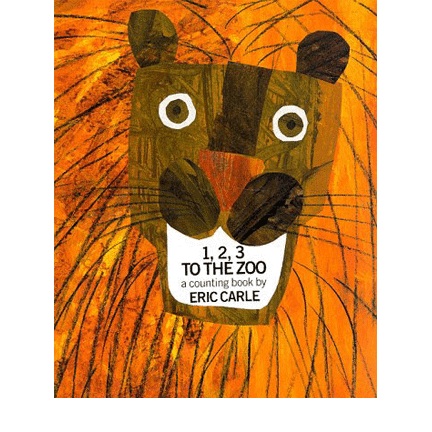
1,2,3 To The Zoo Cover


1,2,3 TO THE ZOO
- numbers from 1 to 10
- animals
- colors


The Mixed-Up Chameleon

THE MIXED-UP CHAMELEON
- animals
- colors
- body parts
- sentence structure ' I wish I could…'


Brown Bear, What Do You See? Cover


BROWN BEAR, BROWN BEAR WHAT DO YOU SEE?
- animals
- sentence structure
- colors


Today is Monday Cover


TODAY IS MONDAY
- food
- animals
- days of the week
- colors
- song at the end of the book http://vimeo.com/23553723


From Head to Toe Cover
FROM HEAD TO TOE
- body parts
- verbs 
- sentence structure 'Can you…?
- an activity idea

Related activities and little handicraft are available on his official web:


I design series of activities based on a communicative method that will help children to practice the grammar they're learning at school.

Many ESL activities, I see, are nothing more than 'fill in the blank' exercises that only teach kids how to fill in blanks and miss the whole point of learning to speak and understand a new language.

It's much easier and more fun to learn by doing, and you'll be surprised at how quickly you'll see valuable results. 

You can get my activities on my online store:

 
Lucy dedicates a lot of time and love to thinking about and writing the posts she shares with all of you. Because she believes that a better teaching is the key for a better future. If you find any help, value or joy in this blog, please consider becoming a supporting reader. A donation, in any amount, will be gratefully accepted.