20.4.14

Popsicle Shapes


'Shapes' is a well known topic when you teach EFL but there's certainly more beyond the 6 or 7 nouns that we usually teach.

Since this year I decided that my Spanish students can learn almost as much as a native speaker in terms of content, I've been designing my classes in a totally different and definitely more interesting way.

One lucky day I came across this page and I had a sort of an epiphany, because popsicle sticks is one of those things that I've always seen in the supply shop where I buy stuff for the classes, but I couldn't imagine a 'real use' for them.

When I say 'real use' I mean that children can use them.

Finally I got one possible answer and this is what I came up with. 

If you follow my FB page you'd have noticed that it took me the whole month of March to complete the activity, but don't worry! It's not a slow and painful process, it's just that I don't have too much free time. Perhaps, a whole afternoon (3 or 4 hours) available would be enough.


Using them with the kids I noticed that it's important to show a picture of the shape you want your students to reproduce in order to point out the number of sides of that same shape.

Around that simple concept of sides you'll be able to work on everything else. Take a look at the picture above for some ideas.

After that, you can leave your children free to create whatever shape they like (irregular ones too) and keep working by themselves on adding sticks and talk about their creations.

More about shapes here and here

--> Quiero leer este post en Español


----------------------------------------------------------------------------------------------------------------------------

🌟 ¡Learning English doesn’t simply mean filling in the blanks! 🇬🇧✨

Many English as a Second Language (ESL) activities rely solely on “fill-in-the-blank” exercises ✏️… but the real goal should be to help children speak, understand, and use English naturally. 🗣️💬

🎨 Learning by doing makes it much easier, more fun, and more motivating!

And you’ll be surprised at how quickly children can start achieving real results. 🌈🚀

📚 If you’re looking for creative and engaging activities to make English learning more dynamic, check out my online store! 🛍️💕

👉 ESL Children's Worksheets

✨ Learn, play, speak, and grow! ❤️

----------------------------------------------------------------------------------------------------------------------------

📍Do you struggle with a challenging class, where many of your students get distracted and their academic performance doesn’t reflect all the effort you put into preparing and teaching your lessons? 

📍Does this situation frustrate you, and would you like your students to learn more while enjoying the process? 

👉Something similar happened to me during my elementary teaching internship, and in my latest book, Pygmalion in the Classroom: A Real Experience—based on my senior thesis and my internship at a primary school in Madrid—I’ll tell you how we managed to turn things around and achieve resounding success! 

Don’t miss it! 

Available in digital and print formats on Amazon in every country, and on the major e-book platforms.


6.4.14

Happy Easter Lesson Plan for Kids

Easter break is round the corner and I'd like to share with you what I planned in order to make it unforgettable for my Spanish pre-schoolers.

First of all I introduced the vocabulary: basket, eggs, bunny, chicks.

Because words become meaningful when they are used, and seen in this case, in a context, I didn't use any flashcards but, instead, these two books:


Then we made our paper basket and filled it with 10 eggs. 

A great  handicraft that we needed to mime this Easter song.

I also planned an Easter egg hunt and, since I don't have my own classroom, I looked for an easy, but still fun, alternative. So, I printed some little eggs  and hid them under colorful cupcake paper cups.

If you're teaching elder children you can write words on the cups to practice reading and pronunciation.

We also made bunny masks and sang this song about sleeping bunnies.

We've been playing an Easter variation of the circle game Duck, duck…Goose! I invented for the occasion: Chick, chick…Bunny!!! 

For some relaxing moments, after hopping and skipping around the classroom, I found a couple of coloring pages of… a bunny and an egg, of course.

Finally, as a surprise for the end of the class, I bought  tons of chocolate eggs and hundreds of special Easter themed stickers!

Enjoy your Easter classes!!!

---> quiero leer este post en español


----------------------------------------------------------------------------------------------------------------------------

🌟 ¡Learning English doesn’t simply mean filling in the blanks! 🇬🇧✨

Many English as a Second Language (ESL) activities rely solely on “fill-in-the-blank” exercises ✏️… but the real goal should be to help children speak, understand, and use English naturally. 🗣️💬

🎨 Learning by doing makes it much easier, more fun, and more motivating!

And you’ll be surprised at how quickly children can start achieving real results. 🌈🚀

📚 If you’re looking for creative and engaging activities to make English learning more dynamic, check out my online store! 🛍️💕

👉 ESL Children's Worksheets

✨ Learn, play, speak, and grow! ❤️

----------------------------------------------------------------------------------------------------------------------------

📍Do you struggle with a challenging class, where many of your students get distracted and their academic performance doesn’t reflect all the effort you put into preparing and teaching your lessons? 

📍Does this situation frustrate you, and would you like your students to learn more while enjoying the process? 

👉Something similar happened to me during my elementary teaching internship, and in my latest book, Pygmalion in the Classroom: A Real Experience—based on my senior thesis and my internship at a primary school in Madrid—I’ll tell you how we managed to turn things around and achieve resounding success! 

Don’t miss it! 

Available in digital and print formats on Amazon in every country, and on the major e-book platforms.


30.3.14

Spring - Lesson plan1 - BUGS

Spring is definitely my favorite season and this time I decided to teach a little bit of science to my preschoolers. Bugs, plants, flowers… 

They are all around and it's interesting for the kids to take a closer look at them, in English too.

I started with the famous, but not environmentally conscious, bumble bee song and then we played that phonic game Bees and Flowers I told you about several posts ago. This time I drew daisies, tulips and sunflowers to make sure my students would learn flowers' names. 

At the beginning the kids were using the more general word flower they already knew and I had to explain them that flowers are like children: each one has a different name.

They seemed kind of enlightened by the concept. It was so cute!

After buzzing around for a while I introduced vocabulary about bugs like, spiders, ladybugs, snails, bees, dragonflies, caterpillars and butterflies, using flashcard games.

To help them remember a couple of the names in the list above you can use these two songs: One about ladybugs and the other about the spider and… prepositions of place!

This second one is not only catchy but also really useful.

To make the most of it and also review numbers from 1 to 20 we played a card game you'll find here on page 13 and 14. Instead of the trowel card my students were hiding and looking for… a spider!

In addition, I used some pages  from these two books: 


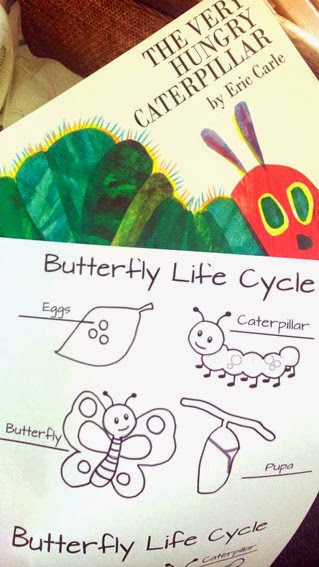
Finally we read The Very Hungry Caterpillar. Actually, we read it again because I had never realized before that it also shows the butterfly life cycle. 

An ESL teacher isn't expected to teach such scientific facts, so I usually use that same book to teach food, days of the week, numbers. It has been surprising to discover a new use of the story after owing it for 6 years.

Here you can download a cute picture of a butterfly life cycle to cut and use as a puzzle.

Next post… flowers and plants!

Meanwhile enjoy the springtime!

----------------------------------------------------------------------------------------------------------------------------

🌟 ¡Learning English doesn’t simply mean filling in the blanks! 🇬🇧✨

Many English as a Second Language (ESL) activities rely solely on “fill-in-the-blank” exercises ✏️… but the real goal should be to help children speak, understand, and use English naturally. 🗣️💬

🎨 Learning by doing makes it much easier, more fun, and more motivating!

And you’ll be surprised at how quickly children can start achieving real results. 🌈🚀

📚 If you’re looking for creative and engaging activities to make English learning more dynamic, check out my online store! 🛍️💕

👉 ESL Children's Worksheets

✨ Learn, play, speak, and grow! ❤️

----------------------------------------------------------------------------------------------------------------------------

📍Do you struggle with a challenging class, where many of your students get distracted and their academic performance doesn’t reflect all the effort you put into preparing and teaching your lessons? 

📍Does this situation frustrate you, and would you like your students to learn more while enjoying the process? 

👉Something similar happened to me during my elementary teaching internship, and in my latest book, Pygmalion in the Classroom: A Real Experience—based on my senior thesis and my internship at a primary school in Madrid—I’ll tell you how we managed to turn things around and achieve resounding success! 

Don’t miss it! 

Available in digital and print formats on Amazon in every country, and on the major e-book platforms.


16.3.14

Phonics - Teaching Reading and Writing (ESL)

http://dollarstoremom.com/2011/04/make-a-phonics-flip-chart/
In one of my previous posts I wrote that my challenge for 2014 was going to be teaching reading and writing in English to some of my students who could already understand and speak English quite well.

Looking for some ideas and advice I came across such an abundance of strategies and material that I almost felt overwhelmed.


However, I've been able to design an effective plan that is already showing some results.


Everything started to become clearer when I was able to take a look at a collection of booklets specifically designed with the purpose of teaching phonics.


It's published by Collins and it's called Collins Easy Learning Age 5-7


It's interesting because the books cover many letter sounds with examples and colorful drawings. Also, there are a couple of workbooks to keep practicing a little more.

I decided to use them as a sort of guide through the maze of phonics, but also as a 'test' to use at the end of each module.


Then, following my 'guide', I searched the internet looking for entertaining activities linked to phonics, first of all because I wanted to dive deep into the topic and second because engaged kids are the secret to successful teaching.


Well… I would say I found a treasure. 


Look at this page and take your time to explore it, because it's an amazing source of almost anything you need to teach this topic.


The worksheets you'll find here are great! Crosswords, puzzles, cut and paste activities, cards. So far my students have enjoyed them a lot.

Furthermore, it's so nice to see how the children are getting more and more confident with every class.

I can see how they are reasoning about what letters they need to write every single word, making a big effort not to peep at the word bank that follows the exercises.

However, the best of all is seeing their eyes light up with satisfaction when they realize that they can spell correctly.

Below, I give you a list of other things I'm using these days to expand the phonics experience:

- Cards to teach Rhyming words and Phonics

- Spelling Games from Instant File-Folder Games for Reading grade 1-3 published by Scholastic
  (sample pages available)


- Success with Reading Comprehension Grade 1, also published by Scholastic
  (sample pages available)


- Dr Seuss rhyming books (Children love them!)

- Alphablocks cartoons. (Very engaging and fun. Available on YouTube)

As you can see, tons of material is available, so I personally selected those phonics that Spanish children would find the trickiest to recognize. I imagine that kids from other countries will need to focus on different sounds and patterns.

Good luck with your work and, as always, have fun!

More about reading

More about writing

---> Quiero leer esta entrada en español

----------------------------------------------------------------------------------------------------------------------------

🌟 ¡Learning English doesn’t simply mean filling in the blanks! 🇬🇧✨

Many English as a Second Language (ESL) activities rely solely on “fill-in-the-blank” exercises ✏️… but the real goal should be to help children speak, understand, and use English naturally. 🗣️💬

🎨 Learning by doing makes it much easier, more fun, and more motivating!

And you’ll be surprised at how quickly children can start achieving real results. 🌈🚀

📚 If you’re looking for creative and engaging activities to make English learning more dynamic, check out my online store! 🛍️💕

👉 ESL Children's Worksheets

✨ Learn, play, speak, and grow! ❤️

----------------------------------------------------------------------------------------------------------------------------
📍Do you struggle with a challenging class, where many of your students get distracted and their academic performance doesn’t reflect all the effort you put into preparing and teaching your lessons? 

📍Does this situation frustrate you, and would you like your students to learn more while enjoying the process? 

👉Something similar happened to me during my elementary teaching internship, and in my latest book, Pygmalion in the Classroom: A Real Experience—based on my senior thesis and my internship at a primary school in Madrid—I’ll tell you how we managed to turn things around and achieve resounding success! 

Don’t miss it! 

Available in digital and print formats on Amazon in every country, and on the major e-book platforms.

27.2.14

On Engagement, Flow and Education

ALAMY. By Graeme Paton, Education Editor

In the Early Childhood Education course I took last month there is a section dedicated to engagement that might be interesting to talk about, as well as children's optimism of course (see my article).

Let's start with the definition of engagement: 

We are engaged with something when we are involved in some activity, that might be challenging, and once we succeed in doing it we feel a great pleasure. 

Using simple words it's when we are doing something that we feel we are really good at, and we enjoy doing it a lot. 

It is a state of mind strictly connected to the psychology of flow.

But, what's flow? 

Flow is a mental state in which a person performing an activity is fully immersed in a feeling of energized focus, full involvement, and enjoyment in the process of the activity. In essence, flow is characterized by complete absorption in what one does (wikipedia article).

It has been studied and proposed by Mr Mihaly Csikszentmihalyi.

Flow's presence has been detected in many fields of the human production and it is connected with happiness and creativity.

Here you can watch a TED conference about it and if you go to minute 14:09 you'll see a summary of the main points that describe flow.

Now the question is: How do engagement and flow have an impact on children's learning process?

Imagine 2 axes on a graph. On one of them we have the level of challenge of a supposed activity and on the other we have the level of skill of the child.

If we assign an overly-challenging task to a child who hasn't got the right level of skill he needs to accomplish it, the kid will feel anxiety and fear.

On the other hand, if we assign a less challenging task to a child who is overly-skilled for that activity then it is likely that he will feel boredom.

However when we give the task with the appropriate level of challenge, maybe just a little bit higher, to the child who has the appropriate level of skill, then we'll witness flow and engagement. In addition we will have provided them with a real learning experience.

And that's really true. Very often we can see children who don't pay attention or aren't doing what they are supposed to do in our classrooms. 

However when we would investigate those 'issues' we can easily find out that, most of the time, they are caused by the fact that the task the children are assigned is too easy or too difficult according to their skill.

Time is another important aspect: children should be given time to develop the whole process. 

So far, a more flexible education model seems to be the most effective tool for improving the unique learning experience of each child. Mr Mihaly Csikszentmihalyi has demonstrated in his articles, where he analyzes the flow experienced in traditional, nontraditional public and private schools around the world, that a different and adequate approach to teaching would produce a greater learning experience. 

This one specifically talks about Montessori schools and this one provides an analysis of a wider number of schools.

----------------------------------------------------------------------------------------------------------------------------

🌟 ¡Learning English doesn’t simply mean filling in the blanks! 🇬🇧✨

Many English as a Second Language (ESL) activities rely solely on “fill-in-the-blank” exercises ✏️… but the real goal should be to help children speak, understand, and use English naturally. 🗣️💬

🎨 Learning by doing makes it much easier, more fun, and more motivating!

And you’ll be surprised at how quickly children can start achieving real results. 🌈🚀

📚 If you’re looking for creative and engaging activities to make English learning more dynamic, check out my online store! 🛍️💕

👉 ESL Children's Worksheets

✨ Learn, play, speak, and grow! ❤️

----------------------------------------------------------------------------------------------------------------------------

📍Do you struggle with a challenging class, where many of your students get distracted and their academic performance doesn’t reflect all the effort you put into preparing and teaching your lessons? 

📍Does this situation frustrate you, and would you like your students to learn more while enjoying the process? 

👉Something similar happened to me during my elementary teaching internship, and in my latest book, Pygmalion in the Classroom: A Real Experience—based on my senior thesis and my internship at a primary school in Madrid—I’ll tell you how we managed to turn things around and achieve resounding success! 

Don’t miss it! 

Available in digital and print formats on Amazon in every country, and on the major e-book platforms.