Showing posts with label printables. Show all posts

30.3.14

Spring - Lesson plan1 - BUGS

Spring is definitely my favorite season and this time I decided to teach a little bit of science to my preschoolers. Bugs, plants, flowers… 

They are all around and it's interesting for the kids to take a closer look at them, in English too.

I started with the famous, but not environmentally conscious, bumble bee song and then we played that phonic game Bees and Flowers I told you about several posts ago. This time I drew daisies, tulips and sunflowers to make sure my students would learn flowers' names. 

At the beginning the kids were using the more general word flower they already knew and I had to explain them that flowers are like children: each one has a different name.

They seemed kind of enlightened by the concept. It was so cute!

After buzzing around for a while I introduced vocabulary about bugs like, spiders, ladybugs, snails, bees, dragonflies, caterpillars and butterflies, using flashcard games.

To help them remember a couple of the names in the list above you can use these two songs: One about ladybugs and the other about the spider and… prepositions of place!

This second one is not only catchy but also really useful.

To make the most of it and also review numbers from 1 to 20 we played a card game you'll find here on page 13 and 14. Instead of the trowel card my students were hiding and looking for… a spider!

In addition, I used some pages  from these two books: 


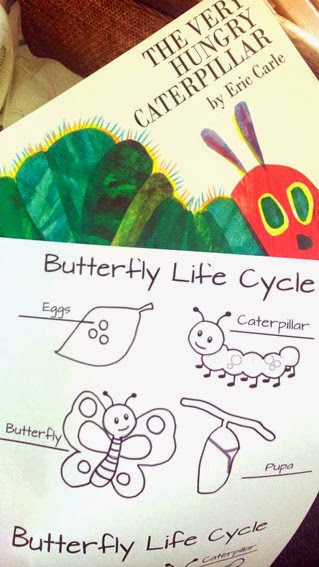
Finally we read The Very Hungry Caterpillar. Actually, we read it again because I had never realized before that it also shows the butterfly life cycle. 

An ESL teacher isn't expected to teach such scientific facts, so I usually use that same book to teach food, days of the week, numbers. It has been surprising to discover a new use of the story after owing it for 6 years.

Here you can download a cute picture of a butterfly life cycle to cut and use as a puzzle.

Next post… flowers and plants!

Meanwhile enjoy the springtime!

----------------------------------------------------------------------------------------------------------------------------

🌟 ¡Learning English doesn’t simply mean filling in the blanks! 🇬🇧✨

Many English as a Second Language (ESL) activities rely solely on “fill-in-the-blank” exercises ✏️… but the real goal should be to help children speak, understand, and use English naturally. 🗣️💬

🎨 Learning by doing makes it much easier, more fun, and more motivating!

And you’ll be surprised at how quickly children can start achieving real results. 🌈🚀

📚 If you’re looking for creative and engaging activities to make English learning more dynamic, check out my online store! 🛍️💕

👉 ESL Children's Worksheets

Learn, play, speak, and grow! ❤️

----------------------------------------------------------------------------------------------------------------------------

📍Do you struggle with a challenging class, where many of your students get distracted and their academic performance doesn’t reflect all the effort you put into preparing and teaching your lessons? 

📍Does this situation frustrate you, and would you like your students to learn more while enjoying the process? 

👉Something similar happened to me during my elementary teaching internship, and in my latest book, Pygmalion in the Classroom: A Real Experience—based on my senior thesis and my internship at a primary school in Madrid—I’ll tell you how we managed to turn things around and achieve resounding success! 

Don’t miss it! 

Available in digital and print formats on Amazon in every country, and on the major e-book platforms.


4.2.14

Winter Lesson Plan


Winter has definitely shown up here in Madrid, therefore it's time to dive deep into this topic with my preschoolers!

I discovered, thanks to a Montessori blog, a Ukrainian folktale called The Mitten written by Jan Brett.

The story is about a white mitten, laying on the snow in the wood, that  soon becomes a shelter for several animals: a mole, a rabbit, an owl, a badger, a fox etc. 

To see how it ends take a look at this video.


The story teaches sequencing and a lot of vocabulary related to forest animals and the winter.

The tale is easy to retell so you can shorten it, printing out the characters cutting out a big white mitten and setting up a little drama time instead of reading the original book. 

At the end sneeze aloud and send the animals flying into the air… The children will be happily surprised!

Some activities to do after the reading and strictly related to the story are: color and decorate your own mitten or color only the animals that appear in the story. 

Here you can find the worksheets.

Then, you can go a step forward and talk about winter clothes, cut them out and stick them inside a handicraft wardrobe to practise there is and there are  

Finally for those of you who have a lot of time to spend in the classroom I would suggest to take a look at this interesting Snow Pack

Happy February!!!


More about WINTER? Take a look at this board game


----------------------------------------------------------------------------------------------------------------------------

🌟 ¡Learning English doesn’t simply mean filling in the blanks! 🇬🇧✨

Many English as a Second Language (ESL) activities rely solely on “fill-in-the-blank” exercises ✏️… but the real goal should be to help children speak, understand, and use English naturally. 🗣️💬

🎨 Learning by doing makes it much easier, more fun, and more motivating!

And you’ll be surprised at how quickly children can start achieving real results. 🌈🚀

📚 If you’re looking for creative and engaging activities to make English learning more dynamic, check out my online store! 🛍️💕

👉 ESL Children's Worksheets

Learn, play, speak, and grow! ❤️

----------------------------------------------------------------------------------------------------------------------------

📍Do you struggle with a challenging class, where many of your students get distracted and their academic performance doesn’t reflect all the effort you put into preparing and teaching your lessons? 

📍Does this situation frustrate you, and would you like your students to learn more while enjoying the process? 

👉Something similar happened to me during my elementary teaching internship, and in my latest book, Pygmalion in the Classroom: A Real Experience—based on my senior thesis and my internship at a primary school in Madrid—I’ll tell you how we managed to turn things around and achieve resounding success! 

Don’t miss it! 

Available in digital and print formats on Amazon in every country, and on the major e-book platforms.